
Let me be honest with you. Two years ago, if someone had told me that I could build a fully functional web app just by describing it in plain English, with no code, no Stack Overflow tabs, and no midnight debugging sessions, I would have laughed out loud. But here we are in 2026, and that is exactly what vibe coding has made possible for millions of people around the world.
The term was coined by AI researcher Andrej Karpathy in early 2025. He described it as a style of software development where you stop writing code line by line and instead describe what you want in plain language, while AI does all the heavy lifting. The idea sounded simple at first, but the impact it has had on the entire software industry has been nothing short of massive.
I have personally tried, tested, and spent real time with each of the tools listed in this article. Some of them blew me away completely. Some frustrated me. A couple genuinely changed the way I work every single day. Whether you are a seasoned developer who wants to ship faster, or someone with zero coding background who just has a brilliant app idea, this guide is going to help you find the right tool for your situation.
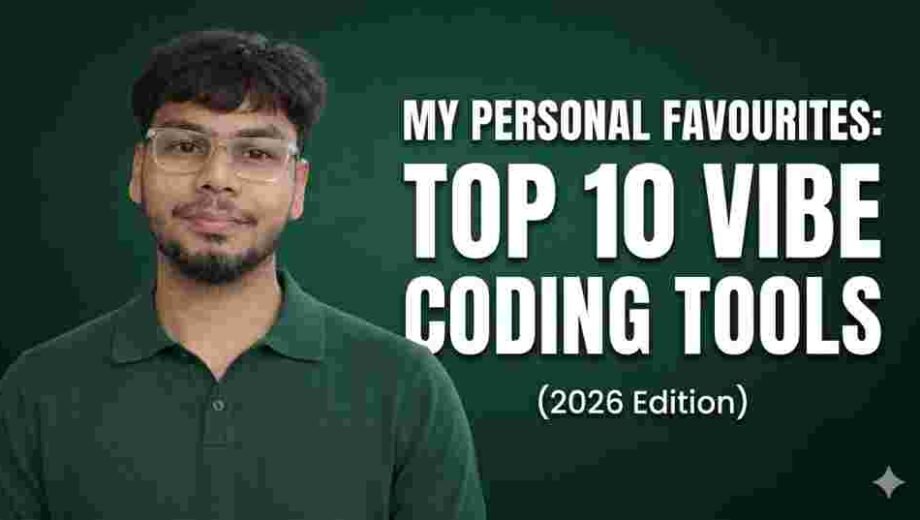
Let us get into it. Here are my top 10 vibe coding tools in 2026, ranked based on real-world use, features, pricing, and who they are actually built for.
What Is Vibe Coding and Why Is Everyone Talking About It?
Before we jump into the tools, let me give you a quick grounding in what vibe coding actually means. It is not about being lazy or skipping the fundamentals. It is about shifting your role from someone who writes every line of code to someone who directs AI with clear intent and purpose.
You describe what you want. The AI interprets your intent and generates the code. You review, refine, and iterate through natural language conversation. Think of it like being the architect instead of the bricklayer. You are still responsible for the design, the logic, and the outcome. The AI just builds faster than any human team ever could.
According to Google Cloud’s official guide on vibe coding, this approach marks the end of an era where software development required years of technical training. And the data backs this up. Vibe coding tools have collectively turned millions of non-coders into creators who can build and launch applications in a matter of hours.
Now, there are two broad types of vibe coding platforms. The first type is full-stack AI app builders like Lovable, Bolt.new, and Hostinger Horizons. These generate complete applications from your description and even handle the hosting for you. The second type is AI-powered code editors like Claude Code, Cursor, and Windsurf. These sit inside your development environment and help experienced developers write, debug, and ship code much faster.
Knowing this distinction is important before you pick a tool. Because using a developer-focused tool when you have zero coding experience is like being handed the keys to a Formula 1 car when you are still learning to drive. Let us make sure you pick the right one for your situation.
Top 10 Vibe Coding Tools in 2026: My Personal Curated List
1. Claude Code: Best for Developers Who Want Deep Control
If I had to pick one vibe coding tool that I trust the most for serious, production-grade work, that tool would be Claude Code, built by Anthropic. And yes, I am aware of the irony here. But my experience with Claude Code has genuinely earned it the top spot on this list, and I want to explain exactly why.
Claude Code is a terminal-based AI coding agent. It runs on the command line and connects directly to your entire codebase. Before it starts working on anything, it shows you its reasoning as clear text output so you know exactly what it is planning to do. You review that plan, approve it, and only then does it start reading files, running commands, making multi-file edits, and proposing fixes on its own.
What sets it apart is the sheer quality of its reasoning. When I gave it a prompt like “Refactor the authentication system and add rate limiting,” it did not just blindly generate code. It explained the approach step by step, pointed out potential conflicts with existing code, and asked for clarification before touching anything. That kind of thoughtfulness is genuinely rare in this space.
Claude Code works best for experienced developers who are comfortable in the terminal and want an AI partner that respects the complexity of their codebase rather than oversimplifying everything.
- Best for: Professional developers, complex multi-file projects, terminal-native workflows
- Pricing: Usage-based via Anthropic API; also available through Claude Pro and Max plans
- Standout feature: Transparent reasoning before execution and agentic multi-file editing
2. ChatGPT with OpenAI Codex and Canvas: Best for Beginners Exploring Vibe Coding
ChatGPT, powered by OpenAI Codex, has arguably done more to popularize vibe coding than any other platform in the world. Its conversational interface makes it the most approachable entry point for anyone who has never written a single line of code in their life.
The Canvas feature, which was rolled out to paid users, is a real game changer in every sense. It lets you write, edit, and refine code in a split-screen environment. You describe a change in plain language, and Canvas applies it directly to the code. You can iterate back and forth, request explanations, and even ask it to convert a Python script to JavaScript, all within the same window without switching tabs.
From a personal standpoint, I have used ChatGPT with Codex to quickly prototype landing page logic and small automation scripts. For those types of tasks, it is genuinely impressive. The limitation becomes visible when you take on larger, more complex projects. You will hit the context window ceiling and start noticing inconsistencies across files, which can slow you down considerably.
OpenAI Codex does not have a standalone subscription. It comes bundled with all paid ChatGPT plans, starting at around $20 per month for the Plus tier. The Pro Plus plan at $60 per month gives you higher usage limits and priority access to the latest models.
- Best for: Beginners, quick scripts, learning to vibe code, prototyping ideas fast
- Pricing: Starts at $20/month, bundled with ChatGPT Plus
- Standout feature: Canvas interface for real-time code editing and iteration
3. Cursor: Best AI Code Editor for Professional Developers
If you have spent any time in developer communities on Twitter or Reddit in the past year, you have definitely seen Cursor being recommended. And the hype is completely justified. Cursor is comfortably the most popular vibe coding tool among professional developers right now, and it has earned that reputation through consistent quality.
Built by Anysphere and launched in 2023, Cursor is essentially VS Code with powerful AI features baked directly into every part of the coding experience. It runs on models like Claude Sonnet and Opus, GPT-5, and Gemini Pro, so you can pick the right model for each specific task. The agent mode writes code across multiple files and runs terminal commands to build entire features without requiring you to switch context or juggle multiple tools at the same time.
What I love about Cursor is how naturally it fits into an existing workflow. If you are already using VS Code, the transition is almost zero friction. You get intelligent autocomplete, in-editor chat, repo-wide AI context, and the ability to give high-level instructions that Cursor translates into actual working code without you having to spell out every single step.
One thing to keep in mind is that Cursor works best when you understand what it is doing under the hood. For complete beginners, the power can feel overwhelming. But for intermediate to advanced developers, it is the kind of tool that genuinely makes you two to three times faster at shipping features.
- Best for: Intermediate to senior developers who want AI inside their editor
- Pricing: Free tier available; paid plans from $20/month
- Standout feature: Multi-model support, deep VS Code integration, agent mode for complex tasks
4. Lovable: Best for Building Beautiful UIs Without Writing Any Code
Lovable calls itself “the world’s first AI fullstack engineer,” and while that is a bold claim, it is not entirely without basis. Lovable is exceptional at one very specific thing: generating visually stunning, production-ready web applications from natural language prompts, and doing it fast.
When I tested Lovable, I described a simple SaaS dashboard concept and within a few minutes I had a working application with a modern UI, proper routing, and a backend integration already connected through Supabase. The visual quality of what it generates is genuinely impressive. Designers and product managers especially tend to love it because the output looks professional without any manual styling work from your side.
Lovable also supports two-way GitHub sync and multiplayer editing, which makes it a viable option for small teams working together on the same project. The native Supabase integration means you get a real backend with proper database schemas and authentication, not just a pretty front-end shell with no substance behind it.
Where Lovable struggles is with complex business logic and large-scale applications. As projects grow in size, the cost can become significant and the AI can sometimes struggle to maintain consistency across a large codebase. But for MVPs, landing pages, and startup prototypes, it is absolutely one of the best tools available today.
- Best for: Founders, product managers, designers, startup MVP development
- Pricing: Free tier available; paid plans start at $25/month
- Standout feature: Supabase native integration, multiplayer editing, beautiful UI generation
5. Bolt.new: Best for Full-Stack Apps Built Directly in the Browser
Bolt.new from StackBlitz is the tool I recommend to people who want to go from an idea to a working, deployed full-stack application without installing a single thing on their computer. It is entirely browser-based, which means zero setup and immediate results the moment you open it.
What makes Bolt.new special is its use of WebContainers technology. It runs a full Node.js environment directly inside your browser tab. This is not a simulation or a simplified version of development. It is an actual working development environment. You can import projects from Figma or GitHub, connect to Supabase for your backend, and deploy your project with a single click.
In my personal testing, Bolt.new was brilliant for rapid prototyping. I built a simple expense tracker application in under 20 minutes. The prompts were responsive, the code came out clean, and deployment took only a few seconds. For non-technical founders who want to validate a product idea quickly, Bolt.new is one of the fastest paths from idea to live URL that currently exists.
The one limitation worth mentioning is that very long or complex vibe coding sessions can sometimes cause the AI to lose context of earlier decisions and start making inconsistent choices. A quick recap prompt at the start of each new session usually helps keep things on track.
- Best for: Non-technical founders, quick full-stack prototyping, zero-setup development
- Pricing: Free tier available; paid Pro and Team plans also available
- Standout feature: WebContainers technology, one-click deployment, Figma and GitHub imports
6. Replit AI Agent: Best All-in-One Coding Platform for Learning and Collaboration
Replit has been around for years as a browser-based coding platform, but its AI Agent mode has completely transformed it into one of the most comprehensive vibe coding environments available today. The core value proposition is wonderfully simple: you go from idea to deployed application without ever leaving your browser tab.
The Replit AI Agent can plan and build entire applications autonomously. You describe your app, it generates a plan, writes the code, installs all the required dependencies, and deploys the finished product in one continuous flow. Built-in hosting means you do not need to worry about setting up Heroku, Vercel, or any other external deployment service separately.
Where Replit really shines is for students, educators, and anyone who wants a collaborative coding environment. Multiple people can work on the same project in real time, which makes it excellent for team learning sessions and pair programming.
The main trade-off is that you have less control over your infrastructure compared to local development setups. For resource-intensive applications, you may eventually hit performance limits. But for the vast majority of learning projects and prototypes, Replit is a genuinely powerful and well-rounded solution.
- Best for: Students, educators, collaborative projects, rapid idea validation
- Pricing: Free tier available; paid plans from $20/month
- Standout feature: Fully autonomous AI Agent, built-in hosting, real-time collaboration
7. v0 by Vercel: Best for Generating Polished React and Next.js UIs in Seconds
v0 by Vercel has a very specific and brilliantly executed purpose. It generates beautiful, production-grade React and Next.js user interfaces from plain text prompts. If you are building web applications within the Vercel ecosystem and you need a fast way to create polished UI components and page layouts, v0 is honestly phenomenal at what it does.
The output quality is consistently impressive across different types of requests. v0 uses Tailwind CSS and shadcn/ui components to generate interfaces that look and feel like they were designed by a professional designer. You describe the component you need, whether that is a pricing table, a dashboard sidebar, or a user profile card, and v0 produces clean and editable React code within seconds.
What I particularly appreciate is the element-level editing feature. You can click on any specific part of the generated UI and refine it with a follow-up prompt in natural language. It also supports Figma imports, which means design teams can translate their existing mockups directly into working code without any manual conversion work.
It is worth being clear that v0 is not a full-stack app builder. It does not handle databases, authentication, or backend logic on its own. Think of it as the world’s fastest UI prototyping tool, one that generates actual shippable code rather than just pretty screenshots or design mockups.
- Best for: Frontend developers, UI-first projects, React and Next.js workflows
- Pricing: Free tier available; Pro and Enterprise plans for higher usage needs
- Standout feature: Production-quality React UI generation, Figma imports, element-level editing
8. Windsurf: Best Cursor Alternative with a Friendlier Learning Curve
Windsurf is often described as Cursor’s younger sibling, and that description captures it fairly well. It is an AI-first code editor that offers a very similar experience to Cursor, but with a noticeably friendlier onboarding process and some meaningful differences in how it handles AI models under the hood.
One thing that stands out immediately about Windsurf is that it automatically scans your existing codebase and builds full context before it starts making any changes. This means it is significantly less likely to make edits that accidentally break something else in the project, which is a genuine pain point that many developers experience with other tools.
Windsurf offers free access to its in-house SWE-1 model, which is a solid performer for everyday coding tasks. If you want to use Claude, OpenAI, or Gemini models alongside it, you will need to bring your own API keys or subscribe to a paid plan. That is a minor inconvenience worth noting before you sign up.
The interface is clean and genuinely user-friendly. In my testing, it handled a habit tracker app quite competently in a single session without any major hiccups. For developers who find Cursor slightly overwhelming at first, Windsurf is an excellent starting point that still delivers serious AI-powered capabilities.
- Best for: Developers new to AI code editors, teams wanting a solid Cursor alternative
- Pricing: Free tier available; paid plans from $15/month
- Standout feature: Automatic codebase scanning for context, clean UI, built-in SWE-1 model access
9. Hostinger Horizons: Best Vibe Coding Tool for Budget-Conscious Beginners
If you are looking for a beginner-friendly vibe coding platform that does not drain your wallet, Hostinger Horizons is one of the most impressive options available in 2026 without a doubt. Launched globally in March 2025, it is built by Hostinger, the same company trusted by over 4 million customers worldwide for web hosting.
What makes Horizons stand out from the crowd is its combination of affordability, ease of use, and sheer breadth of features. Plans start at just $6.99 per month, which is the most competitive pricing I have seen anywhere in the vibe coding market. Even at that entry-level price, you get built-in hosting, a free professional email, and full access to the AI builder without any significant restrictions on core functionality.
Under the hood, Horizons uses a smart mix of Gemini 3 for coding tasks and Claude Sonnet for complex multi-step instructions. These models are intelligently routed through a gateway system that selects the best model for each specific task. This approach has reportedly improved response accuracy quite significantly since the platform first launched.
What I found most impressive during my own testing was the auto-fix feature. When the AI generates code that has errors, Horizons detects those errors automatically and resolves them without requiring any manual intervention from the user. For a complete beginner, that kind of built-in hand-holding is genuinely invaluable and removes a lot of the frustration that usually comes with early-stage vibe coding.
Horizons also holds a very unique distinction in the market. It is currently the only vibe coding platform with comprehensive native ecommerce capabilities built right in. On the Starter plan and above, you can manage an online store with up to 1,000 products through a dedicated store manager, without needing any third-party integrations at all. For Indian entrepreneurs wanting to build and sell online without hiring a developer, this is a genuinely significant advantage over every other tool on this list.
The platform supports over 80 languages as well, which means you can literally describe your app idea in Hindi and it will understand and build accordingly. That makes it one of the most accessible vibe coding tools in the world for non-English speaking users globally.
- Best for: Beginners, solopreneurs, small business owners, ecommerce MVPs, Indian market users
- Pricing: Plans from $6.99/month (Explorer) up to $79.99/month (Hustler); 7-day free trial available
- Standout feature: Most affordable in the market, native ecommerce, 80+ language support, auto-fix errors
10. OutSystems: Best Vibe Coding Platform for Large Enterprise Teams
OutSystems sits in a completely different league from every other tool on this list. This is not a platform for weekend projects or startup MVPs. OutSystems is an enterprise-grade AI development platform trusted by over 2,000 customers including Fortune 500 companies, and it is built specifically for teams that need to ship mission-critical applications with proper governance, security, and scalability baked in from day one.
The platform combines a traditional low-code visual development environment with a powerful AI layer called Mentor. With Mentor, you describe your application requirements in natural language and it generates complete application blueprints including data models, user interfaces, and screens. OutSystems calls this approach “enterprise vibe coding,” which is a fitting description for what it actually does.
OutSystems also launched Agent Workbench in late 2025, which allows organizations to build custom AI agents that automate workflows, integrate with core enterprise systems like SAP and Dynamics, and handle complex business processes. The key advantage here is that agents can securely access proprietary data and internal APIs without the data exposure risks that come with generic LLMs.
Gartner has named OutSystems a Leader in the Magic Quadrant for Enterprise Low-Code Application Platforms for nine consecutive years, which tells you a great deal about the level of trust it commands in the enterprise market. The pricing is custom and not publicly listed, which is standard for platforms operating at this scale.
If you are an IT leader at a large organization looking to accelerate development without compromising on security or governance, OutSystems is the most mature and capable option in the entire vibe coding ecosystem today.
- Best for: Enterprise teams, IT leaders, large organizations, regulated industries
- Pricing: Custom enterprise pricing; contact OutSystems directly for a quote
- Standout feature: Mentor AI assistant, Agent Workbench for enterprise AI agents, built-in compliance
Quick Comparison: Which Vibe Coding Tool Should You Pick?
| Tool | Best For | Pricing Starts At | Coding Skills Needed? |
|---|---|---|---|
| Claude Code | Pro developers, complex codebases | Usage-based (API) | Yes (Advanced) |
| ChatGPT + Codex | Beginners, quick scripts | $20/month | No |
| Cursor | Pro developers, VS Code users | $20/month | Yes (Intermediate+) |
| Lovable | Founders, startup MVPs | $25/month | No |
| Bolt.new | Full-stack prototyping in browser | Free tier available | No |
| Replit AI Agent | Students, educators, teams | $20/month | No |
| v0 by Vercel | Frontend devs, React/Next.js UI | Free tier available | Helpful |
| Windsurf | Developers, Cursor alternative | $15/month | Yes (Intermediate) |
| Hostinger Horizons | Beginners, solopreneurs, ecommerce | $6.99/month | No |
| OutSystems | Enterprise teams, IT leaders | Custom pricing | Yes (Team setup) |
My Personal Verdict: Which Vibe Coding Tool Do I Actually Use Daily?
After spending real time with all ten of these platforms, here is where I personally land.
For my day-to-day work on complex projects, Claude Code is my primary choice without question. The reasoning quality and the transparency of its decision-making process give me a level of confidence that I simply do not get from any other tool currently available.
When I need to spin up a UI quickly or prototype an idea visually, I reach for v0 by Vercel first, and then use Cursor for the actual implementation side of things. Together, these two tools form a workflow that is genuinely hard to beat for web development in 2026.
For friends and colleagues who are non-technical but want to build something real, I always recommend Hostinger Horizons first. The pricing is approachable for most budgets, the interface is genuinely friendly, and the built-in ecommerce functionality makes it useful for people who want to sell products online without hiring a developer or learning any code.
And if someone is just starting out and wants to understand what vibe coding feels like before committing to anything, ChatGPT with Canvas remains the most accessible and forgiving entry point available in 2026.
Conclusion: The Future of Building Software Has Already Arrived
Vibe coding is not a gimmick or a temporary trend. It is a genuine and permanent shift in how software gets built, and it is happening right now in front of our eyes. The tools on this list represent the best of what is currently available, covering everything from beginner-friendly platforms like Hostinger Horizons and Bolt.new, to developer powerhouses like Claude Code and Cursor, and enterprise-grade systems like OutSystems.
The most important thing is to choose a tool that honestly matches your current skill level and the complexity of what you are trying to build. Start simple, iterate fast, and do not be afraid to try a few different options before settling on one. Most of these platforms offer free trials or generous free tiers, so there is no good reason not to experiment before spending any money.
If you are an Indian entrepreneur or developer reading this, the timing has genuinely never been better to start building. The barrier to entry for creating software has dropped dramatically. An idea that would have required a team of five engineers and six months of work two years ago can now be prototyped by a single motivated person over a weekend. That is the real promise of vibe coding, and these tools are absolutely delivering on it right now.
Frequently Asked Questions About Vibe Coding Tools
What is vibe coding in simple terms?
Vibe coding is a way of building software where you describe what you want in plain language, and an AI tool generates the actual code for you. Instead of writing code line by line, you guide the AI with natural language instructions and refine the output through conversation. It is software development driven by intent rather than syntax.
Is vibe coding suitable for someone with zero coding knowledge?
Yes, several vibe coding tools are specifically designed for non-technical users. Platforms like Hostinger Horizons, Bolt.new, Lovable, and ChatGPT with Codex require no prior coding experience at all. You simply describe your idea and the AI builds it for you. That said, having a basic understanding of how software works will always help you give better prompts and get more useful results from any tool.
Which vibe coding tool is best for building a startup MVP?
Lovable and Bolt.new are the most popular choices for startup MVP development right now. Lovable excels at generating beautiful UIs with real backend functionality through its native Supabase integration. Bolt.new is fast, entirely browser-based, and great for getting a working prototype live very quickly. If budget is a concern, Hostinger Horizons is an excellent and much more affordable alternative, especially if your MVP involves selling products online.
Can professional developers benefit from vibe coding tools?
Absolutely. Tools like Claude Code, Cursor, and Windsurf are specifically built with professional developers in mind. They do not replace coding skills in any way. They amplify those skills significantly. Developers using these tools consistently report being two to three times faster at shipping features compared to their traditional development workflows.
Is vibe coding safe for production applications?
It depends on the tool being used and how carefully the output is reviewed. For simple to medium complexity applications, well-reviewed vibe coding output is generally production-safe. For enterprise and mission-critical applications, platforms like OutSystems offer built-in governance, security controls, and compliance frameworks that make it suitable for production at real scale. Always review and test AI-generated code thoroughly before deploying it to production.
Which vibe coding tool is cheapest for Indian users?
Hostinger Horizons is currently the most affordable vibe coding platform on the entire market, with plans starting at just $6.99 per month. It also supports multilingual prompts, which means you can interact with it in Hindi or other Indian languages, making it especially accessible for users across India. Bolt.new and v0 by Vercel also offer genuinely functional free tiers if you want to get started without spending anything at all.
What is the difference between vibe coding and traditional no-code tools?
Traditional no-code tools like Bubble or Webflow rely on drag-and-drop interfaces and visual editors. Vibe coding tools are driven entirely by natural language prompts and AI generation. With vibe coding, you describe outcomes in plain English and the AI generates actual working code. This makes vibe coding faster for prototyping and significantly more flexible than most traditional no-code platforms, though it can sometimes produce less predictable results on very complex business logic that requires precise configuration.